
The EUDR clock is running: what Malaysian rubber and palm exporters must have ready by 30 December 2026
What the EU Deforestation Regulation demands of Malaysian rubber and palm supply chains before it applies to large operators on 30 December 2026.
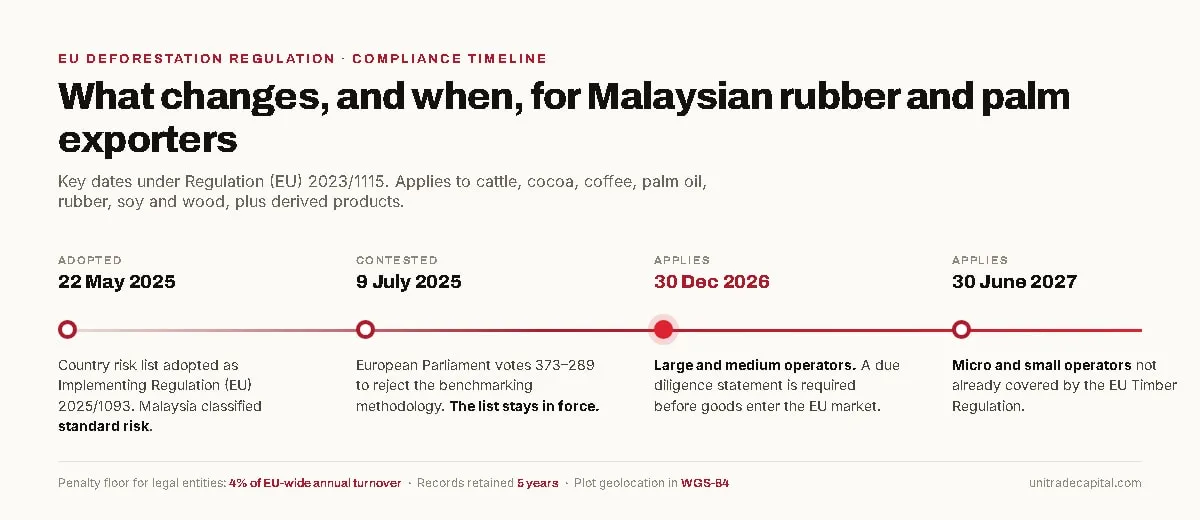
For anyone shipping natural rubber or palm products into Europe, the single most consequential date in the calendar is 30 December 2026. That is when the EU Deforestation Regulation, Regulation (EU) 2023/1115 and universally shortened to EUDR, starts applying to large and medium operators. From that day, a consignment of latex, ribbed smoked sheet, crude palm oil or a covered derivative cannot be placed on the EU market unless somebody has filed a due diligence statement standing behind it.
Malaysian exporters have had a long run-up to this. What has changed recently is that the remaining ambiguity has burned off. The scope is settled, the country classifications are in force, and European buyers have moved from asking whether their suppliers are preparing to asking for the actual coordinates.
What the regulation actually requires
EUDR covers seven commodities: cattle, cocoa, coffee, palm oil, rubber, soy and wood, together with a long list of derived products. Two of those sit at the centre of Malaysia’s export economy.
The obligation is not a certification scheme, and this is the point most often misunderstood. There is no EUDR label to buy. Instead, an operator placing goods on the EU market must be able to demonstrate three things simultaneously:
The goods must be deforestation-free, meaning produced on land that was not deforested after 31 December 2020. They must be legally produced under the laws of the country of production: land tenure, environmental rules, labour law, tax, trade and customs. And the operator must have exercised due diligence, which means collecting the evidence, assessing the risk, and mitigating it where the risk is not negligible.
The evidentiary heart of it is geolocation. The due diligence statement requires the country of production and the geolocation coordinates of every plot of land where the commodity was produced. Coordinates are submitted in WGS-84, entered manually or uploaded as GeoJSON. Documentation must be retained for at least five years from the date the product is placed on the market or exported.
For a plantation-scale estate this is administratively tedious but conceptually simple. For a supply chain that aggregates material from thousands of independent farms, it is a genuine structural problem.
The cut-off date does more work than people expect
Almost every practical difficulty in an EUDR file traces back to one date: 31 December 2020. Land that was forest on that date and has since been converted produces non-compliant material, regardless of whether the conversion was lawful under Malaysian law. Legality and deforestation-free status are separate tests, and a consignment has to pass both.
This catches people out because the intuition runs the other way. A grower who obtained every required permit, cleared land entirely within the law, and can produce the paperwork to prove it will still fail the deforestation-free test if the clearing happened after the cut-off. Conversely, land converted decades before 2020 is fine on that limb even though the historical conversion was, in environmental terms, far larger.
What satisfies the test in practice is evidence about land cover at a fixed point in the past, which is why the compliance conversation keeps arriving at satellite imagery. A plot polygon is checked against historical forest-cover data for the relevant period. That is also why accurate polygons matter more than approximate ones: a boundary drawn loosely around a smallholding can sweep in adjacent land that fails the test, contaminating an otherwise clean plot. Precision in the mapping stage is not pedantry. It is the difference between a plot that clears and one that raises a flag.
Why this lands harder on rubber than on palm
Malaysia’s two flagship commodities arrive at EUDR from very different starting positions.
Palm oil has spent a decade building certification infrastructure. Roughly 90% of oil palm estates hold Malaysian Sustainable Palm Oil certification, with independent smallholders at around 85%, according to figures cited by the Minister of Plantation and Commodities in June 2026. MSPO also became mandatory for palm oil dealer licence renewal from 1 January 2026. None of that automatically discharges an EUDR obligation, because certification is evidence, not a substitute for due diligence, but it means the traceability plumbing, the registries and the audit habits already exist.
Natural rubber has no equivalent legacy. The structural reason is smallholder dominance. Department of Statistics Malaysia figures for March 2024 attribute 88.5% of national natural rubber production to the smallholder sector, against 11.5% from estates. A smallholder here is defined by RISDA as a grower with a plantation area not exceeding 40 hectares, and in practice many holdings are a tiny fraction of that.
Consider what the geolocation requirement means against that backdrop. A single container of block rubber may consolidate latex or cup lump that passed through village-level dealers before reaching a processing factory. Historically nobody needed to know which plot any given kilogram came from, because the material was fungible, and that fungibility was a feature of the market. EUDR removes it. Every plot has to be identified, mapped, and shown to have been non-forest on 31 December 2020.
The Malaysian Rubber Board has responded with the Malaysian Sustainable Natural Rubber standard, a national scheme intended to give the sector the traceability and legality documentation that EUDR conversations now demand. The direction of travel is right. The volume of smallholders to be enrolled is the hard part.
The standard-risk classification, and why the argument about it is not over
On 22 May 2025 the Commission adopted its country benchmarking as Implementing Regulation (EU) 2025/1093. It sorts producing countries into low, standard and high risk. Around 140 countries were placed in the low-risk band. Only four countries were classified high risk: Belarus, North Korea, Myanmar and Russia.
Malaysia was classified standard risk, alongside Indonesia and Brazil.
The classification is not cosmetic. Low-risk sourcing attracts a simplified due diligence regime; standard risk requires the full assessment and mitigation cycle. In practical terms, a Malaysian consignment carries a heavier compliance load than a functionally identical consignment from a low-risk origin.
Kuala Lumpur has objected publicly, and the substance of the objection is worth stating plainly, because it is a factual argument rather than a rhetorical one. Malaysia reduced primary forest loss by 65% between 2014 and 2023, and achieved a further 13% reduction in 2024. The position is that a methodology which places a country with that trajectory in the same band as producers with materially worse records is measuring the wrong thing.
That criticism found an echo inside the EU’s own institutions. On 9 July 2025 the European Parliament voted 373 to 289 to reject the benchmarking system, objecting to opaque methodology, reliance on historic data, and the geographic imbalance of a list on which only four countries were high risk. The rejection did not remove the list. The classification was adopted by implementing regulation and remains in force.
So exporters are operating under a classification that the Parliament formally criticised but that still governs their compliance burden. Plan against the rules as they stand, not as they are argued about.
Scope keeps moving, and the derivative list is where it bites
In July 2026 the Commission confirmed adjustments to the product scope, taking effect 30 December 2027. Some products come out: cattle hides and leather, retreaded tyres, articles of vulcanised rubber, conveyor and transmission belts, soybeans for sowing, and vehicle and aircraft seats. Others go in: soluble coffee, frozen cattle tongues, and certain palm oil derivatives, including soap made with palm oil.
For a trading company the lesson is narrower than the headline. Scope is defined by customs classification, not by the commodity in the abstract. Two products from the same mill can sit on opposite sides of the line, and that line moved once and may move again. The operative question for any given shipment is which HS code it travels under, and whether that code is in scope on the date it enters the EU.
What buyers are asking for now
Ahead of the December 2026 date, the requests arriving from European counterparties have converged on a fairly consistent set.
Plot-level geolocation, supplied as GeoJSON rather than a description. Evidence of legal production: licences, land title or tenure documentation, and proof of compliance with local law. A documented chain of custody from plot to shipment, showing where material was aggregated. Mill or factory identity for palm consignments. And a contractual allocation of who files the due diligence statement, since the operator carries the liability.
That last point deserves attention from anyone negotiating supply terms. Penalties for legal entities are set at a floor of 4% of total annual EU-wide turnover from the preceding financial year, alongside confiscation of non-compliant goods and the revenue derived from them. Where an EU importer is the operator, that exposure sits with them, and they will push documentary obligations up the chain into the sales contract. Read those clauses carefully.
A practical position
The regulation is not a reason to retreat from the European market. Compliance is administratively demanding, but it is achievable, and the exporters who solve it first inherit an advantage over those still assembling paperwork in December.
Three things are worth doing regardless of how the benchmarking argument resolves. Establish where your material physically comes from, at plot resolution, and record it in a format a buyer can submit. Keep legality documentation in a form that survives an audit years later, given the five-year retention requirement. And confirm the customs classification of every product line against the current scope list, then re-confirm it before December 2027.
Traceability is becoming a condition of market access rather than a premium feature. That is the durable change, and it will outlast the specific arguments about risk bands.
Unitrade Capital Solution supplies palm and oleochemicals, rubber and latex, industrial chemicals and paper to buyers in over 20 countries, and is a registered member of the Malaysia Rubber Association (LGM) licensed to export Standard Malaysian Rubber. If you are working through documentation requirements for a European shipment, tell us what you need and we will tell you what we can evidence.
This article is general information about a regulatory development and is not legal advice. Verify obligations against the official text of Regulation (EU) 2023/1115 and current Commission guidance before relying on them.
Sources
- Commission updates product scope and tools to support EUDR European Commission, Directorate-General for Environment
- Implementing the EU Deforestation Regulation (EUDR) European Commission, Green Forum
- EUDR country risk benchmarking rejected: what this means for compliance Coolset
- Malaysia says its 'standard' risk classification under EUDR is unfair OFI Magazine
- MSPO certification rate for oil palm estates reaches 90% Asia Palm Oil Magazine
- Monthly Rubber Statistics, March 2024 Department of Statistics Malaysia (DOSM)
- EUDR compliance for rubber exporters in Malaysia TraceX Technologies
- What is the EU Deforestation Regulation? World Resources Institute