
The paperwork that decides whether your chemical container sails
Classification, the dangerous goods declaration, the packing certificate and the verified gross mass decide whether an industrial chemical container loads.
A container of industrial chemicals is rarely stopped because the chemistry is wrong. It is stopped because a form is. The material in the drums is exactly what the contract says, the analysis certificate is clean, and the box still sits on the quay because a four-digit number on a declaration does not match the label on the packaging.
Shipping hazardous chemicals by sea is governed by rules that most buyers never read and every buyer eventually pays for. This is a plain account of what those rules require, who signs what, and the specific points where shipments fail.
Two rule sets, answering to different authorities
The first thing to separate is which rules apply where.
The sea leg is governed by the International Maritime Dangerous Goods Code, issued by the International Maritime Organization. It decides whether a consignment may be carried on a ship at all, how it must be packed, marked and stowed, and what paperwork must travel with it.
Supply inside Malaysia is a different matter, governed by the Department of Occupational Safety and Health under the CLASS Regulations. Those rules decide what a supplier must tell you about a chemical before it ever reaches a port.
The two overlap but are not interchangeable. A safety data sheet that satisfies a workplace regulator is not a transport document, and a correct dangerous goods declaration does not discharge a supplier’s duty to classify and label. Buyers who assume one covers the other are the ones who find the gap at the terminal gate.
The IMDG Code, and why its amendment number matters
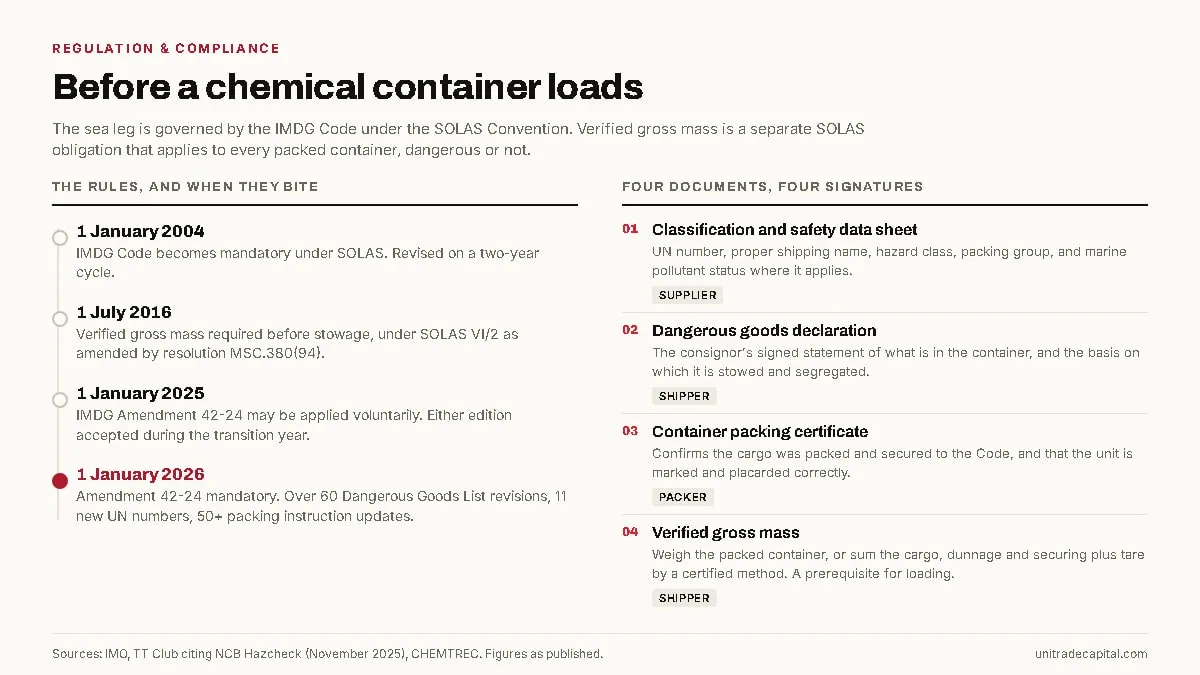
The IMDG Code has been mandatory under the SOLAS Convention since 1 January 2004. It is revised on a two-year cycle, drawing on proposals from member governments and on changes to the United Nations recommendations underneath it.
That cycle is not academic. Amendment 42-24 became mandatory on 1 January 2026, after a transition year in which either the previous edition or the new one could be used. From that date the previous edition is no longer valid for a new shipment.
The scale of the revision is worth knowing before assuming last year’s documents still work. TT Club, citing NCB Hazcheck analysis published in November 2025, records over 60 revisions to the Dangerous Goods List, 11 new UN numbers, more than 50 updates to packing instructions and over 30 modifications to special provisions.
The practical consequence is narrow and irritating. Documentation that still cites the superseded amendment can be rejected even where the underlying classification has not changed at all. If you hold safety data sheets prepared before 2026, the transport section is the one to check first.
Classification is the decision everything else inherits
Every other requirement follows from classification, which is why it is the step worth spending money on.
Classification assigns four things: a UN number, which is a unique four-digit code; a proper shipping name, which is the official designation rather than the trade name on your purchase order; one of nine hazard classes; and, where applicable, a packing group reflecting the degree of danger.
A fifth element catches people out. A substance harmful to the aquatic environment must additionally be identified as a marine pollutant and marked accordingly. This applies to materials that are otherwise unremarkable to handle, and it is a common source of mismatch between a commercial description and a transport description.
Classification also drives segregation. Incompatible substances must be kept apart under the Code’s segregation table, so that oxidising materials are not stowed alongside flammable solids. That is a stowage decision made by the carrier, but it is made from the information the shipper declared. Declare it loosely and the carrier plans around the wrong hazard.
The two documents that travel with the box
For a packed container of dangerous goods, two documents do the work.
The dangerous goods declaration is the shipper’s statement of what is inside. It carries the UN number, proper shipping name, hazard class, packing group where one applies, and the quantity. The consignor completes and signs it, and that signature is a certification rather than an administrative formality.
The container packing certificate confirms that the cargo was packed and secured in accordance with the Code: that the right packages went in, that they are compatible, that they are restrained, and that the unit is correctly marked and placarded on the outside.
Training sits behind both. Personnel involved in the transport of dangerous goods must receive function-specific instruction covering general awareness, safety and emergency response. A declaration signed by someone never trained to read a Dangerous Goods List entry is a liability wearing the costume of compliance.
Verified gross mass is a separate obligation, and it also stops containers
One requirement is easy to overlook because it has nothing to do with hazard classification and applies to every packed container, not only dangerous ones.
Under SOLAS chapter VI, regulation 2, as amended by resolution MSC.380(94) and in force since 1 July 2016, the shipper must provide a verified gross mass for a packed container before it is stowed aboard. Two methods are permitted: weighing the packed container, or weighing all packages, dunnage and securing material and adding the container’s tare mass, using a certified method approved by the competent authority.
The IMO is explicit that a verified gross mass is a prerequisite for loading. It is not a guarantee of loading, because the master keeps the discretion to refuse a container. Where no figure has been provided, the master or the terminal may obtain one, and the cost of that lands somewhere in the commercial chain. Agree in advance where.
What a Malaysian supplier owes you before the goods move
Malaysia implements the Globally Harmonized System through the CLASS Regulations, gazetted on 11 October 2013, with the supporting Industry Code of Practice aligned to UN GHS Revision 3.
The duties fall on suppliers, a category that takes in manufacturers, importers, formulators and distributors. They must classify hazardous chemicals, label and package them accordingly, and compile safety data sheets. Suppliers of one tonne or more per year of a hazardous chemical must also submit an annual inventory, due by 31 March for the preceding year.
For a buyer this is leverage rather than trivia. A Malaysian supplier operating properly already holds a classification and a current safety data sheet for everything it sells. Asking for both at enquiry stage, before a price is agreed, tells you a great deal about whether the shipment will move cleanly, and it costs nothing to ask.
Where shipments actually fail
The failure modes are documented and consistent.
The National Cargo Bureau’s container inspection work, reported by the International Institute of Marine Surveying in September 2023 when a second initiative was launched, found 55% of inspected containers non-compliant, with 43% failing on poorly secured dangerous goods and 6.5% carrying misdeclared dangerous cargo.
Read those proportions carefully, because the largest single category is not fraud. It is securing. Most non-compliance is a packing problem created by people loading a box quickly, rather than a deliberate misdeclaration. That is encouraging, in the sense that it is fixable with instruction and supervision rather than enforcement.
The misdeclaration figure is smaller but far more consequential, because a misdeclared consignment is stowed as though it were something else. Segregation decisions, and the ship’s emergency response, are then built on a description that is not true.
Nor is that first sample the worst result on record. The National Cargo Bureau also reports a targeted remote inspection programme run in South Africa for a major shipping line, in which 74% of containers failed on non-compliant loads and 37% were found to have been stuffed with misdeclared or undeclared dangerous goods. A targeted programme is designed to find problems and its numbers should not be read as an industry average, but the direction is unambiguous: where inspectors look hard at dangerous goods, they find a great deal.
The lesson for a buyer is that this is a supervision problem with a known shape. It concentrates in who packs the box and who checks it, not in exotic chemistry.
What to ask for before you book
Five questions settle most of it, and all five can be asked before a purchase order exists.
Ask for the UN number, proper shipping name, class and packing group in writing, not a general assurance that the material is safe. Ask which IMDG amendment the transport section of the safety data sheet is written against. Ask whether the material is classified as a marine pollutant. Ask who is packing the container and who signs the packing certificate. Ask how the verified gross mass will be determined and who pays for the weighing.
None of these is an unusual request, and a supplier who cannot answer them quickly is telling you something useful about how the shipment will go. The paperwork is not an obstacle to the trade. It is the trade, written down.
Unitrade Capital Solution supplies industrial chemicals, palm and oleochemicals, rubber and latex and paper to buyers in over 20 countries. If you need classification and documentation confirmed for a chemical shipment before you commit to an order, tell us what you need and we will tell you what we can evidence.
This article is general information about transport and chemical safety requirements and is not legal or technical advice. Verify obligations against the current IMDG Code, the SOLAS Convention and the CLASS Regulations before relying on them.
Sources
- Dangerous Goods International Maritime Organization (IMO)
- Verification of the gross mass of a packed container International Maritime Organization (IMO)
- TT Talk: IMDG Code Amendment 42-24 TT Club
- Breaking Down IMDG Regulations: What Every Shipper Needs to Know CHEMTREC
- Malaysia CLASS Regulations (GHS) ChemSafetyPro
- NCB launches second container inspection initiative to battle the dangers of misdeclared cargo International Institute of Marine Surveying (IIMS)
- NCB Container Inspections Safety Initiative National Cargo Bureau