
FOB, CFR or CIF: where risk actually transfers on a commodity shipment
The Incoterms 2020 rules fix where delivery happens and where risk passes. What FOB, CFR, CIF and FCA mean for a commodity cargo, and what they leave out.
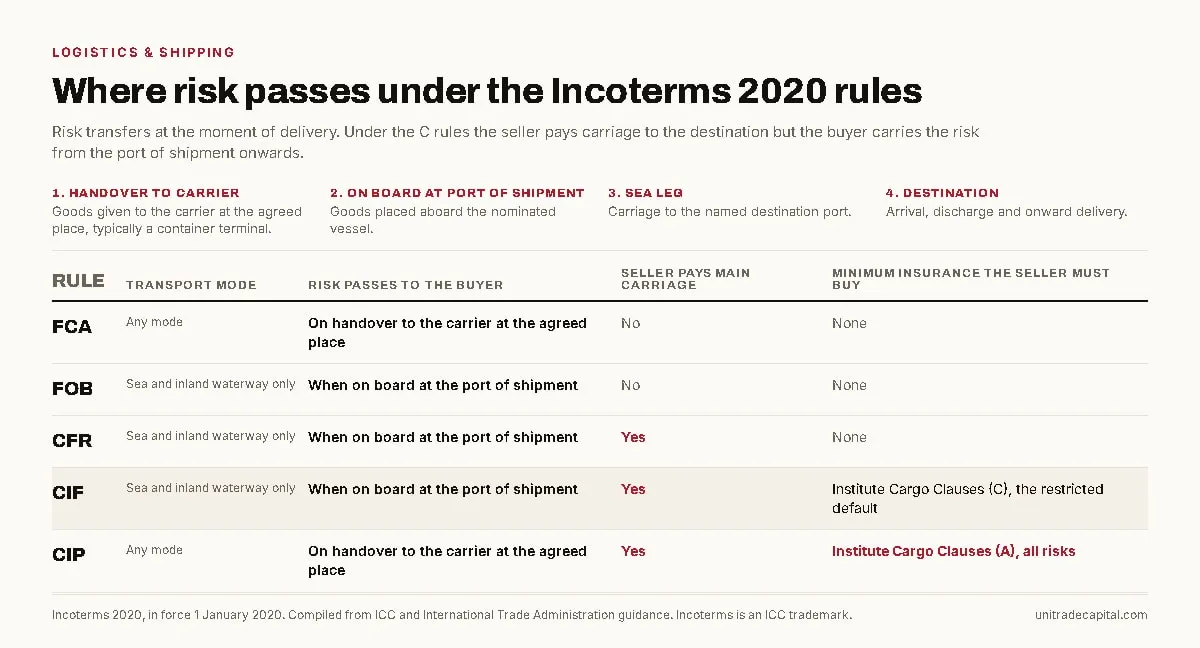
Three letters in a purchase order decide who absorbs the loss when a cargo is damaged at sea. Most buyers choose those three letters out of habit, copying whatever the last contract said, and only discover what they agreed to when something has gone wrong.
Incoterms for commodity shipments are not a pricing convention. They are a statement of where the seller’s delivery obligation ends, and therefore where the buyer’s risk begins. Those two points are the same point, which is the single most useful thing to understand about the whole system.
What the rules are, and what version applies
The Incoterms rules are published by the International Chamber of Commerce. The current edition is Incoterms 2020, and the International Trade Administration advises that from 1 January 2020 sales contracts should reference it.
There are 11 rules. Seven work for any mode of transport. Four are for sea and inland waterway carriage only: FAS, FOB, CFR and CIF.
Earlier editions have not been withdrawn, and a contract may still validly reference Incoterms 2010. That is exactly why the edition has to be named. Writing “CIF Port Klang” without a year leaves open which rulebook governs, and the rulebooks are not identical. Name the rule, the place and the edition, every time.
Two changes in the 2020 edition are worth knowing if you are working from older templates. DAT, delivered at terminal, was renamed DPU, delivered at place unloaded, and the restriction to a named terminal was dropped so that the rule now covers any agreed place and any mode of transport. Separately, security-related obligations were written through all the rules, so that transport security requirements are allocated explicitly rather than left to argument. Neither change is dramatic, but a contract that still says DAT is quoting a rule that no longer exists in the current edition.
Delivery and risk are the same moment
The organising principle is that the transfer of risk coincides with delivery. Whatever else a rule allocates, the moment the seller has delivered is the moment the buyer starts carrying the risk of loss or damage.
The C rules are where this stops being intuitive. Under CFR, CIF and CIP the seller pays for carriage to a named destination, but the buyer carries the risk from the point of delivery, which is far earlier. The seller pays the freight to Rotterdam and stops being at risk in Port Klang.
This is not a drafting oversight. It is the design. A C rule splits cost and risk deliberately, so the seller can sell on delivered-price terms while the cargo travels at the buyer’s risk. Buyers who read “cost and freight to my port” as “the seller’s problem until it arrives at my port” have misread the rule in a way that only becomes expensive after a casualty.
FOB, CFR and CIF: same risk point, different costs
The three maritime rules used most often in commodity trade share one risk point and differ in what the seller pays for.
Under FOB, the seller delivers when the goods are on board the vessel nominated by the buyer at the named port of shipment, and risk passes at that moment. The buyer contracts and pays for the sea carriage.
Under CFR, risk still passes when the goods are placed on board at the port of shipment. The seller is deemed to have performed its delivery obligation at that point regardless of whether the goods arrive in sound condition, in the right quantity, or at all. The difference from FOB is that the seller contracts and pays for carriage to the destination port. The seller owes no obligation to insure.
Under CIF, risk again passes on board at the port of shipment, and the seller pays freight, but the seller must also contract for insurance covering the buyer’s risk of loss or damage.
So the practical hierarchy is simple. All three put risk on the buyer from the moment of loading. FOB leaves freight to the buyer, CFR puts freight on the seller, and CIF adds insurance on top.
The insurance level under CIF is lower than most buyers assume
This is the detail that causes the most trouble, because the word “insurance” in CIF does considerably less work than it sounds like it does.
Under CIF, the ICC states that Institute Cargo Clauses (C) remain the default level of cover, with the parties free to agree something higher. Clauses (C) are a restricted set of named perils, not all-risks cover. A seller meeting its CIF obligation to the letter can buy the cheapest compliant policy, and that policy may not respond to the loss the buyer actually suffers.
CIP is the contrast. Incoterms 2020 raised CIP to require cover compliant with Institute Cargo Clauses (A), which is the extensive all-risks level. The ICC’s reasoning tracks the cargo: bulk commodities typically move on CIF, while manufactured goods typically move on CIP and tend to need the higher cover.
For a buyer of bulk material, there are two honest options. Accept Clauses (C) and understand the gap, or specify a higher level expressly in the contract rather than assuming CIF delivers it. The default is the minimum, not the norm.
There is also a timing trap. Under CIF the seller delivers on board and the buyer’s exposure starts immediately, so late notice of loading can leave a buyer without time to arrange any additional cover it intended to buy. Fix the notification obligation in the contract.
Containers changed which rule fits
FOB, CFR and CIF were built for a world in which the seller handed goods across the ship’s side. Containerised cargo does not work that way. The seller hands the box to a terminal or a carrier days before it is loaded, and then has no control over it at all.
The ICC’s guidance is to use FCA rather than FOB for containers. Under FCA the seller delivers, and risk passes, when the goods are handed to the carrier at the agreed place, which matches what physically happens. FOB keeps the seller at risk through a period when the container is already in someone else’s custody.
Incoterms 2020 removed the practical objection to FCA. The buyer and seller may now agree that the carrier will issue an on-board bill of lading to the seller once the goods are loaded, which is what a documentary credit usually demands. That was the main reason traders stayed with FOB, and it no longer applies.
The decision therefore follows the cargo, not the habit. Break-bulk and genuinely bulk parcels loaded directly aboard still suit FOB, CFR and CIF. Containerised cargo, including material shipped in flexitanks, drums or bales, is better served by FCA, CPT and CIP.
Most of what this company ships falls on the containerised side of that line. Palletised bales of natural rubber and drummed or flexitank concentrated latex all move as full container loads, handed to a terminal well before the vessel loads. Quoting them FOB is defensible by convention, but it is not the rule that best describes what happens to the cargo.
Name the place precisely, because the rule alone is not enough
An Incoterm without a properly specified place is an argument waiting to happen. The ICC Academy’s worked example is a contract naming “CIF Qingdao City”, where Qingdao has multiple ports with different inland transport costs, and the seller may reasonably pick the cheaper one while the buyer expected another. The consequence is unplanned haulage, storage and delay.
The fix is to write the place as precisely as the operation requires: a named port, and where it matters the specific terminal or berth. The same discipline applies at the origin end. “FCA seller’s warehouse, Port Klang” and “FCA Westports container terminal” are different contracts.
What Incoterms do not do
Finally, the limits, because they are routinely over-read.
The rules do not say when title or ownership passes. That is governed by the sale contract and the applicable law, and it is entirely separate from risk. It is possible to bear the risk in goods you do not yet own.
They do not fix the method or timing of payment, they do not determine liability for goods that fail specification, and they do not resolve who is responsible for delay. A documentary credit, a quality clause, a force majeure clause and a dispute resolution clause all still have to be written.
That is the right way to think about the three letters. They settle delivery, risk, cost allocation and the division of customs and security duties, cleanly and in a form every counterparty understands. Everything else in the deal is still yours to negotiate.
Unitrade Capital Solution supplies rubber and latex, palm and oleochemicals, industrial chemicals and paper to buyers in over 20 countries, on terms agreed shipment by shipment. If you want a quotation set out on a specific Incoterms 2020 rule and named place, tell us what you need and we will price it that way.
This article is general information about a set of contractual rules and is not legal advice. Verify the wording against the official ICC text of the Incoterms 2020 rules, and take advice on your own contract before relying on it.
Sources
- Incoterms 2020 International Chamber of Commerce (ICC)
- Know Your Incoterms International Trade Administration, U.S. Department of Commerce
- Incoterms 2020 vs 2010: What's changed? ICC Academy
- Incoterms 2020: FCA or FOB? ICC Academy
- Incoterms 2020: CFR or CIF? ICC Academy
- Incoterms 2020: CIP or CIF? ICC Academy
- Place of delivery and risk transfer in international trade contracts ICC Academy