
How much actually fits in a 20-ft container of rubber, latex or resin
Container loading sets your freight cost per tonne. What fits in a 20-ft box of rubber bales, latex drums, flexitanks and bagged powders, and why.
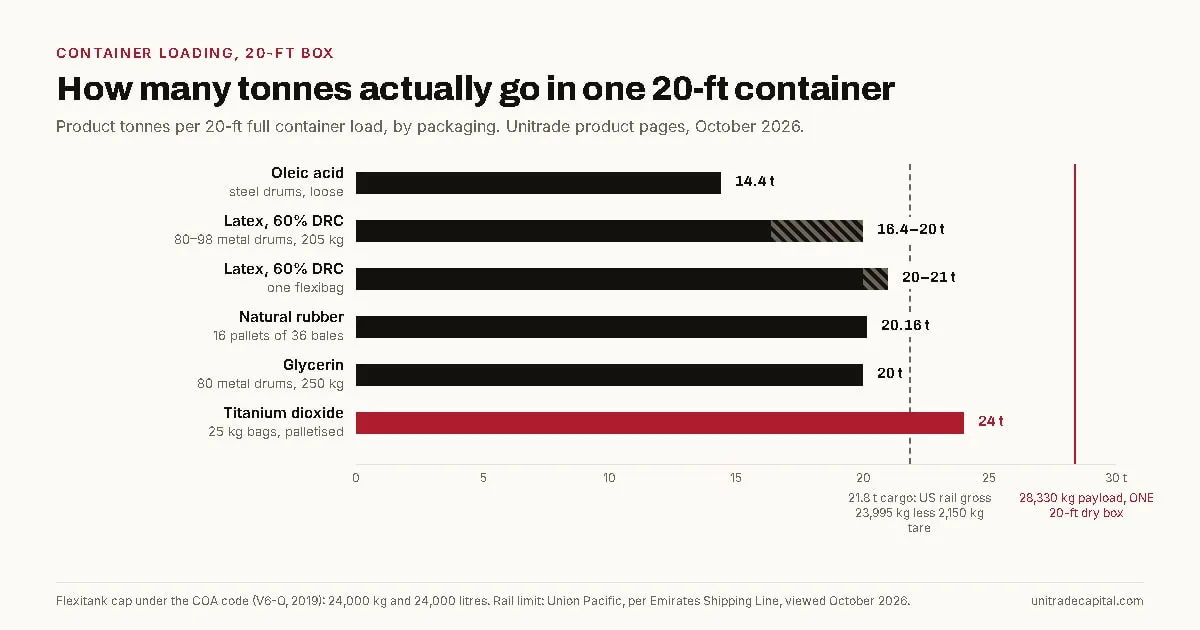
Container loading is the line most buyers skip on a quotation, but it decides what each tonne pays in freight. The same 20-ft box can arrive with 14.4 tonnes of product or with 24 tonnes. If the freight is the same for both, the lighter load pays about 67% more freight per tonne.
The worked examples below use the loadings on our own product pages as of October 2026, so they are figures a buyer will see on a real offer. The box data comes from a carrier, and the flexitank rules come from the industry code.
What a 20-ft container can carry
ISO 668 sets the sizes and ratings for Series 1 freight containers. Its 20-ft sizes carry the codes 1C and 1CC, and 1CC is the 8 ft 6 in high unit. The strength tests, however, sit in a companion standard, ISO 1496-1.
Ocean Network Express (ONE) publishes typical figures for its 20-ft dry container. As checked in October 2026, they are:
- inside: 5,898 mm long, 2,350 mm wide and 2,390 mm high
- door opening: 2,340 mm wide and 2,280 mm high
- capacity: 33.1 m³
- tare, meaning the empty box: 2,150 kg
- maximum gross weight: 30,480 kg
- payload: 28,330 kg
Those numbers are not universal, though. ISO 668 raised the maximum gross mass for a 20-ft unit to 30,480 kg in 2005, up from 24,000 kg. Then in 2016 it rose to 36,000 kg. Since older and newer boxes still work side by side, the limit for any one container is the figure on its CSC safety approval plate.
Container loading runs out of weight or space, whichever comes first
Every load hits a ceiling, but not always the same one. Dense cargo such as titanium dioxide gets close to the weight limit first. Light cargo such as PVC resin, by contrast, fills the 33.1 m³ long before it nears 28 tonnes.
A third ceiling sits between them, and that is the floor. Pallets and drums stand on the floor, and they stack only as high as the packaging allows. So a load can stop well short of both the payload and the cubic capacity.
That is the lens for the figures below. So when a supplier states a container loading, it is telling you which ceiling the product hits first.
Container loading for rubber bales: palletised or loose
Our natural rubber supplier page lists a 35 kg bale and a shrink-wrapped pallet of 36 bales at 1.26 MT. Its loading reads “1 Container, 20-ft FCL (16 Pallets) = 20.16 MT”. FCL means a full container load booked by one shipper.
That is about 8 tonnes short of ONE’s 28,330 kg payload. Weight is not the constraint, so the floor and the stack set the limit instead.
Ribbed smoked sheet also shows how much the bale format matters. For Thai sheet, the page gives “1 Bale = 111.11 kg” and “1 Container, 20-ft FCL (171 Bales) = 19 MT”. Indonesian sheet in 113 kg bales loads “162 Bales” for 18.306 MT. Vietnamese sheet, in 33.33 kg or 35 kg bales, loads 19.2 MT or 20.16 MT.
Pallets also add weight that is not rubber. The wood, film and strapping all count towards the gross mass, so they count against road limits too.
Our nitrile rubber line shows the same pattern with fewer bales. KUMHO KNB at “1 Pallet (30 Bales) = 1.05 MT” loads “1 Container, 20-ft GP (16 Pallets) = 16.80 MT”. GP means general purpose, the ordinary dry box. It is still 16 pallets, but with 30 bales on each instead of 36, the box carries 3.36 tonnes less.
Liquids: drums, IBCs or a flexitank
With liquids, packaging moves the loading most. Our concentrated latex supplier page lists two options for 60% DRC latex, where DRC is dry rubber content:
- “1 Container, 20-ft FCL (80–98 Metal Drums) = 16.4–20 MT”, in 205 kg internally lined drums
- “1 Flexi Bag, 20-ft FCL = 20–21 MT”
A flexitank, also called a flexibag, is a single-use bladder that fits inside a general purpose container. The Container Owners Association (COA) code, version V6-O of July 2019, caps a flexitank at 24,000 kg and 24,000 litres. It also bars any liquid classed as dangerous goods under the IMDG Code. TT Club reported in 2014 that PAS 1008, the British Standards specification, uses the same 24,000 kg ceiling.
The UK P&I Club’s 2023 Carefully to Carry guidance gives a typical range of 10,000 to 24,000 litres. It also names latex as a flexitank cargo. By its estimate, a flexitank holds about 40% more than drums and about 15% more than IBCs.
Our own figures show a smaller gap, so the difference matters. Against 80 drums, the flexibag carries up to 28% more latex. Against 98 drums, though, the gain is only about 5%. The drum count is therefore the first thing to pin down when you compare offers.
Flexitank container loading
A flexitank also has to be nearly full, because a slack load moves. The P&I guidance warns that a part-filled bag lets the liquid surge, which can damage the box. It recommends a flow meter to fill within 500 litres of nominal capacity. Because ISO 1496-1 ties sidewall strength to payload, the guidance also wants a 20-ft flexitank box rated to 30,480 kg or more.
So for latex, container loading by flexitank wins on tonnes, but only by about 5% against the heaviest drum load.
Drums still earn their place. Our refined glycerin page lists “1 Container, 20-ft FCL (80 Metal Drums) = 20 MT” in 250 kg drums. Oleic acid in loose steel drums, however, loads 14.4 MT. An IBC, or intermediate bulk container, is a caged tank on a pallet base. Polyurethane in 1,000 kg IBCs loads “1 Container, 20-ft GP (20 IBCs) = 20 MT”, while Synthomer NBR latex loads 18 MT.
Bagged powders: dense pigment, light resin
For powders, container loading depends on density as much as on weight. Two powders on our list sit at opposite ends of the scale. Titanium dioxide, in 25 kg paper bags that are shrink-wrapped and palletised, loads “1 Container, 20-ft FCL = 24 MT (Palletized)”. That is close to the weight ceiling.
PVC resin, however, is the reverse. Our PVC resin supplier page quotes “1 Container, 40-ft FCL = 25 MT (Palletized)”, so it uses a 40-ft box. Sasol’s data sheet for one K67 suspension grade, S6721, issued in January 2018, gives an apparent density of 560 g/L. On that figure, 33.1 m³ of resin with no gaps at all would weigh about 18.5 tonnes. Bags, pallets and air then take their share, so a 20-ft box runs out of volume well before weight.
Other bagged chemicals show how the packing pattern moves the total. EDTA loads “1 Container, 20-ft GP (800 Bags) = 20 MT”. TMTD uses the same 25 kg bag. Still, it loads “1 Container, 20-ft GP (400 Bags / 20 Pallets) = 10 MT”, half the tonnage. Calcium stearate and Flexicoat, in 200 kg drums with pallets, both load 80 drums for 16 MT.
VGM and the road leg cap the load before the ship does
Since 1 July 2016, SOLAS has required a verified gross mass, or VGM, for each packed container before it goes aboard. The shipper declares it. The IMO allows two methods: weigh the packed box, or weigh every package, pallet and piece of dunnage, then add the tare. Our article on shipping hazardous chemicals by sea covers the procedure itself.
Still, the tighter limit is often on land. Emirates Shipping Line’s US page, viewed in October 2026, sets out an example. Union Pacific allows a 20-ft box 52,900 lb by rail, or 23.995 tonnes, cargo plus tare. A heavy-weight surcharge applies above 44,000 lb. Washington State also caps a truck at 36 tonnes gross vehicle weight, unless the haulier holds a heavy-load permit.
Then set the titanium dioxide load against that rail limit. With ONE’s 2,150 kg tare, 24 MT of product weighs 26.15 tonnes. So it is about 2 tonnes over, before pallets. If your plant sits on a leg like that, you may need a lighter load than the supplier’s standard figure. Limits differ by country and sometimes by state, so the haulier at destination is the source to check.
Why container loading sets the price per tonne
Full container freight is quoted per box, not per tonne. So the freight in each tonne is the box rate divided by the tonnes inside.
Take any rate you like, because the ratios hold. Latex at 16.4 MT carries 22% more freight per tonne than latex at 20 MT. Oleic acid at 14.4 MT carries 39% more than glycerin at 20 MT. TMTD at 10 MT carries twice the freight per tonne of EDTA at 20 MT. The same arithmetic applies to destination charges, such as terminal handling and inland haulage, when the terminal or haulier bills them per box.
On an FCA or FOB offer the buyer books the freight, so a light load hits the buyer directly. On CFR or CIF the seller pays, but the loading still sits inside the price. Our Incoterms article explains where each rule puts that cost. In both cases, compare offers on the same loading, or the cheaper number may not be the cheaper cargo.
Questions to settle before the booking
Ask for these in writing with the quotation:
- the packaging, and how many units go in one container
- palletised or loose, and the pallet material
- net and gross weight per container, and the VGM method
- for a flexitank, the fill volume and the container’s rated gross weight
- whether the gross weight fits the road or rail limit at destination
Then compare like with like, since two offers at one price but different loadings are not the same offer.
Unitrade Capital Solution supplies palm and oleochemicals, rubber and latex, industrial chemicals and paper to buyers in over 20 countries. If you need a quotation that states the loading for your grade, tell us what you need and we will come back to you.
This article is general information and is not technical or legal advice. Ratings and road limits vary by box, route and country, so check the CSC plate, your carrier and the IMO before relying on it.
Sources
- Container Information | ONE Ocean Network Express (ONE)
- ISO 668 Wikipedia
- Verification of the gross mass of a packed container International Maritime Organization (IMO)
- Code of Practice - flexitank operators (V6-O 07.2019) Container Owners Association (COA)
- Carefully to Carry Consolidated Edition 2023, Chapter 34: Flexitanks UK P&I Club
- TT Talk - Implementing standards for flexitanks TT Club
- United States of America - ESL | Emirates Shipping Line Emirates Shipping Line
- Product Data Sheet: Polyvinyl Chloride S6721 Sasol