
Wintering and monsoon rain: how the tree's calendar sets natural rubber supply
Natural rubber supply falls from February to May as trees winter, and heavy rain stops tapping. What 2026 data show, and how to time your purchases.
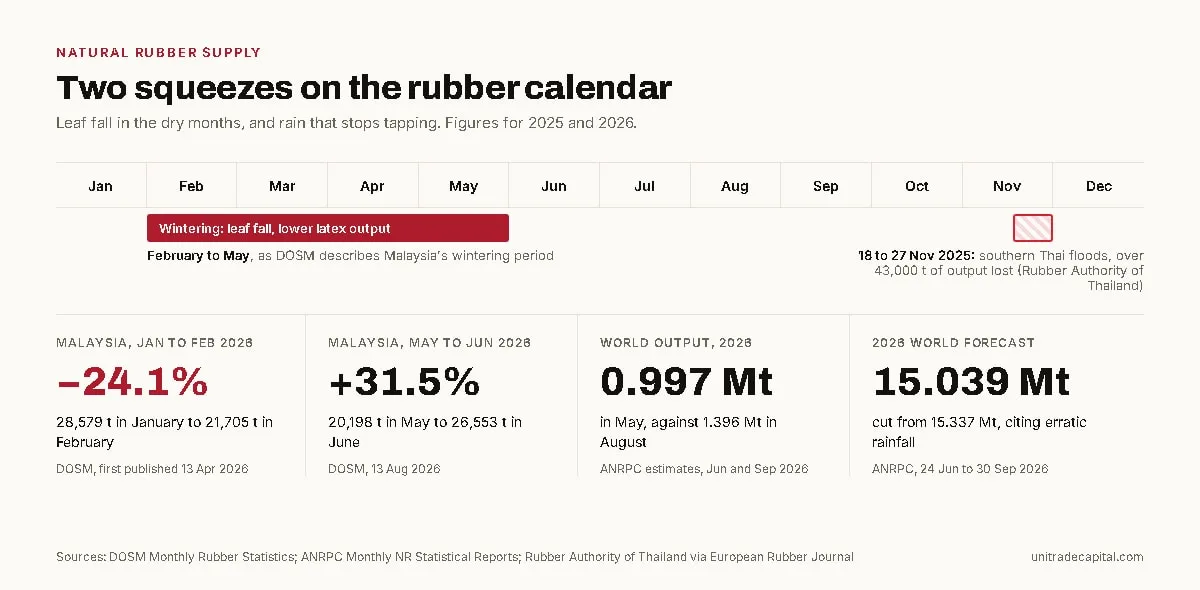
Natural rubber supply follows the tree, not the purchase order. Every year, rubber trees across Southeast Asia shed their leaves and latex output falls. Then the rains come, and on the worst days nobody can tap at all.
Those two events decide when a contract is easy to fill and when it is not. That holds for block rubber, sheet and concentrated latex alike. This article sets out what the 2025 and 2026 data show, and how a buyer can plan around them.
What wintering is, and when it happens
Wintering is the annual leaf fall of the rubber tree, Hevea brasiliensis. It has nothing to do with cold. Instead, the tree drops its old canopy in the drier months and grows a new one. While it does so, latex output falls.
Malaysia’s Department of Statistics (DOSM) puts it plainly. In its February 2020 release, it said the annual wintering period “typically falls between February and May”. That is when the leaves wither and fall. In that month, Malaysian output fell 29.2% to 46,881 tonnes, from 66,232 tonnes in January 2020.
The pattern is regional, not just Malaysian. The Association of Natural Rubber Producing Countries (ANRPC) issued its May 2026 report on 24 June 2026. It blamed lower world output on the wintering period, as well as on dry weather across Southeast and South Asia.
How far natural rubber supply drops in the wintering months
The global estimates show the size of the dip. ANRPC put world output at 997,000 tonnes in May 2026, down 4.7% on May 2025. For August 2026, well after the wintering months, its estimate was 1.396 million tonnes.
On those estimates, the world produced roughly 29% less rubber in May 2026 than in August 2026. Still, not all of that gap was leaf fall. ANRPC itself pointed to dry weather in May, so part of the shortfall was rain that did not arrive.
Malaysia’s 2026 figures trace the same curve month by month. DOSM recorded 28,579 tonnes in January 2026. In February, output fell 24.1% to 21,705 tonnes, as first published on 13 April 2026. May output was still only 20,198 tonnes. Then, in June, it jumped 31.5% to 26,553 tonnes.
The quarterly totals agree. Output in the second quarter was 65,266 tonnes. That was 8.1% below the first quarter’s 71,013 tonnes, since April and May both fall in the second quarter.
So the Malaysian curve has a clear shape. Natural rubber supply eases in February, stays low through May, and recovers in June.
Why yields fall, and why tapping through does not help
A tree that is replacing its whole canopy has less to give. In Thailand, growers respond by resting their trees. A six-year Thai trial appeared in the Journal of Rubber Research in 2017. It noted that farmers typically stop for about three months over the wintering and summer season. They then tap as often as they can once conditions turn favourable.
The same study asked whether that rest costs rubber. It found that it did not. Cutting the rest from three months to none gave no significantly higher yield per tree over six years of tapping. In other words, tapping through wintering does not add rubber over the life of the tree. So growers have little reason to change the habit.
The trial also tested different months of rest, as well as different lengths. When rest is a grower’s choice rather than a rule, it can still vary from farm to farm. So do not assume every Thai plot stops on the same date.
For a buyer, that is the useful part. The seasonal gap comes from how growers manage their trees. Therefore, treat it as a fixed feature of the calendar, rather than a shortfall that higher prices will quickly fill.
Rain and monsoon: the second squeeze on rubber supply
Wintering is a dry-season problem. Rain is the wet-season one, and it can remove supply far faster.
Late November 2025 showed how fast. The European Rubber Journal reported on 2 December 2025 what the Rubber Authority of Thailand had said. Flooding had affected more than 4.1 million rai (656,000 hectares) of rubber land in nine southern provinces from 18 November. The authority estimated that over 43,000 tonnes of production had “disappeared from the system” between 18 and 27 November. That was because farmers could not tap.
Too little rain hurts as well. The Indonesian Rubber Research Institute followed mature IRR 118 trees in South Sumatra from 2020 to 2022. Its study appeared in Agromet in 2024. It found lower yields in the dry season. Also, latex yield fell consistently whenever soil moisture dropped below 21.5%.
ANRPC made the same point at world level in its August 2026 report. It linked weaker output to erratic rainfall and drier conditions in Southeast Asia. It also put August 2026 production 4.51% below August 2025.
So a buyer faces two risks in one year. The first is the predictable February to May dip. The second is weather, which can hit at either end of the rainfall scale.
Country by country: what a buyer can check
Each origin has its own calendar, and the public data on natural rubber supply differ in depth.
Malaysia publishes the most detailed monthly series. DOSM releases production, stocks and exports for each month. For example, the February 2026 data came out on 13 April 2026, and the June data on 13 August 2026. Smallholders produced 87.0% of February 2026 output and 88.7% of June 2026 output. So the national figure moves with smallholder tapping.
Thailand shows both effects. There is the long wintering rest that the 2017 trial described. There is also monsoon flooding in the south late in the year, as November 2025 proved.
Indonesia has the South Sumatra evidence on dry-season yields. However, that study covers one experimental field in one province. When you buy SIR or Indonesian sheet, ask which province a lot comes from.
Vietnam is harder to pin down. We could not verify an official Vietnamese calendar for wintering, so this article does not give one. ANRPC data do show that Viet Nam’s exports rose 5.63% in August 2026. Its May 2026 report also expected 2026 growth to come mainly from Thailand, China, India and Malaysia. Indonesia and Viet Nam, by contrast, were easing.
Planning SMR, STR, SIR, SVR, RSS and latex purchases
The practical rule is to contract for the lean months before they start. If your plant needs steady deliveries from February to May, agree them before February. By then, natural rubber supply is already tightening.
Block rubber. You may buy SMR, STR, SIR or SVR from a natural rubber supplier. If so, agree February to May shipments early, and consider accepting more than one origin. A contract that allows SMR or STR, for instance, gives the seller more room if one country is tight.
If a seller cannot confirm a February loading by December, that is useful in itself. It tells you to look at a second origin while there is still time.
Stocks, sheet and latex in the lean months
Malaysian stocks also help. DOSM counted 139,985 tonnes of natural rubber stocks in February 2026. In June 2026, the figure was 129,524 tonnes, and processors held about 78% of it in both months. Stocks cushion the dip, but they also fell by about 10,000 tonnes over that period.
Ribbed smoked sheet. Our RSS rubber comes from Thailand, Indonesia, Vietnam, India and Myanmar. So the origins do not all share one calendar. If you buy sheet for a fixed production run, ask which origin is loading. Also ask in which month the sheets were made.
Concentrated latex. As a concentrated latex supplier, we source 60% DRC latex from Thailand and Vietnam. Both sit inside the region where ANRPC reported wintering and dry weather in May 2026. Therefore, a glove maker planning a year of dipping should spread contracts across the calendar. Buying month to month leaves the lean months to chance.
Whatever the product, natural rubber supply is easier to plan when the contract names a shipment window rather than a single date. Then agree in advance what happens if a weather event stops tapping. That is far easier to settle in October than in March.
Reading rubber supply data without being misled
Seasonal data are easy to misread, so three habits help.
First, compare like with like. Malaysia’s February 2026 output was down 24.1% on January, which fits the wintering pattern. But it was also down 39.7% on February 2025. That second figure says something about the year, not the season.
Second, expect forecasts to move. In its May 2026 report, ANRPC projected 2026 world production at 15.337 million tonnes. Its August 2026 report, released on 30 September 2026, put the figure at 15.039 million tonnes. Although the change is under 2%, it shows that weather can revise a forecast within one quarter.
Also check which countries drove a revision. For example, the August 2026 cut reflected revised Thai production for 2025, as well as updated 2026 estimates for Thailand, Malaysia and Indonesia.
Third, note when a figure was first published. Monthly releases are preliminary, so check the latest release before you quote a number in a negotiation.
None of this makes natural rubber supply unpredictable. If anything, the wintering dip is the most reliable event in the rubber year. The buyers who struggle are the ones who meet it in March as a surprise.
Unitrade Capital Solution supplies palm and oleochemicals, rubber and latex, industrial chemicals and paper to buyers in over 20 countries. We are a registered member of the Malaysian Rubber Board with an approved licence to export SMR. If you want to plan shipments around the wintering season, tell us what you need and we will come back to you.
This article is general market information and is not trading advice. Check the latest DOSM and ANRPC releases before relying on any figure.
Sources
- Monthly Rubber Statistics Malaysia, February 2020 Department of Statistics Malaysia (DOSM)
- ANRPC releases Monthly NR Statistical Report, May 2026 Association of Natural Rubber Producing Countries (ANRPC)
- Monthly Rubber Statistics, February 2026 Department of Statistics Malaysia (DOSM)
- ANRPC releases Monthly NR Statistical Report, August 2026 Association of Natural Rubber Producing Countries (ANRPC)
- Monthly Rubber Statistics, June 2026 Department of Statistics Malaysia (DOSM)
- Thailand floods disrupt rubber output European Rubber Journal
- Effects of Different Tapping Rest Periods during Wintering and Summer Months on Dry Rubber Yield of Hevea Brasiliensis in Thailand (Journal of Rubber Research, 20(4), 2017) CIRAD Agritrop
- Climate Influences on Latex Yield in South Sumatra, Indonesia Agromet, IPB University