
Lauric CBS, CBE or CBR: choosing the right cocoa butter alternative for compound coatings
Lauric CBS, CBE and CBR compared for compound chocolate buyers: raw materials, cocoa butter tolerance, tempering and the EU 5% vegetable fat rule.
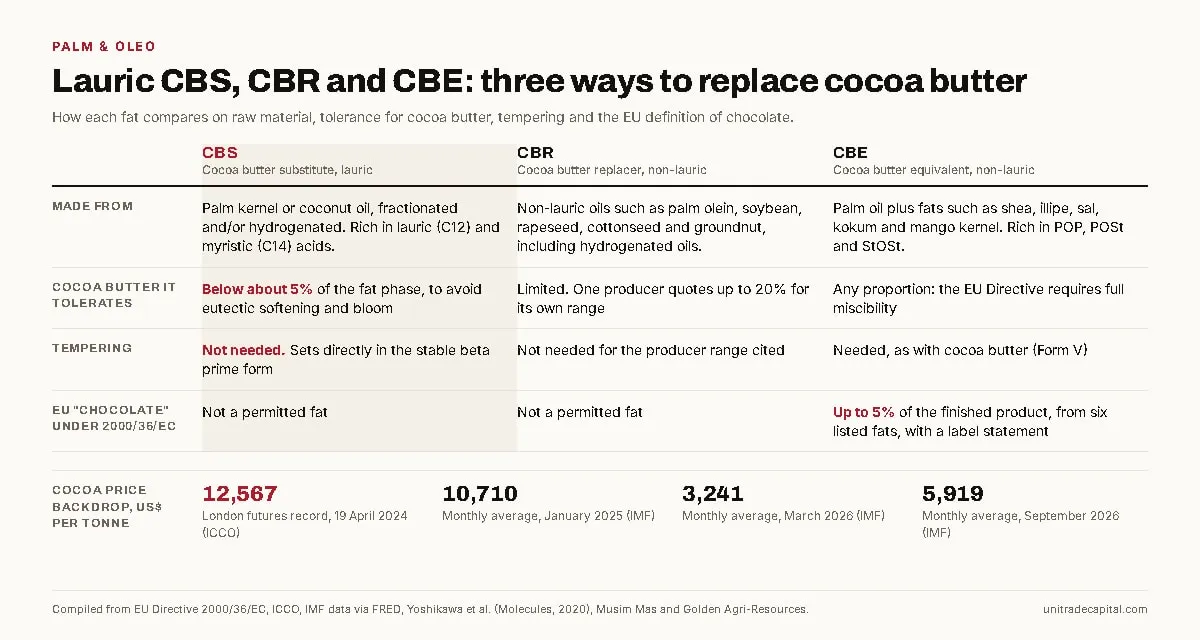
Choosing between lauric CBS, a CBE and a CBR sets a coating’s recipe, its process and the name on its label. All three fats stand in for cocoa butter. However, they behave very differently once they meet it.
A wrong choice shows up late, as bloom on a stored bar or a pack that cannot legally say “chocolate” in the EU. This guide explains each fat, its limits and what to write into a contract.
Why cocoa prices pushed buyers towards alternative fats
Cocoa butter is the expensive part of a chocolate recipe, so its price drives the search for alternatives.
The International Cocoa Organization (ICCO) recorded record futures prices on 19 April 2024. They reached US$12,567 per tonne in London and US$11,878 in New York. Over the 2023/24 cocoa year, the ICCO indicator price averaged US$4,769 per tonne, up 123%. The ICCO linked the rise to a third straight supply deficit, which it estimated at 441,000 tonnes.
Prices then fell, but not smoothly. The IMF’s monthly cocoa series, published by the St. Louis Fed, shows US$10,710 per tonne in January 2025. It then shows US$3,241 in March 2026 and US$5,919 in September 2026. So the monthly price fell by about 70% and then rose by over 80%, all between January 2025 and September 2026.
The ICCO record is a futures price, while the IMF figure is a monthly average. Therefore, compare each number only with its own series.
High prices also cut demand. In its November 2025 market report, the ICCO said elevated prices “have led to a significant reduction in both industrial and consumer demand for cocoa”. So a fat that takes cocoa butter out of the recipe also takes out much of that price risk.
Three fats, three chemistries: lauric CBS, CBR and CBE
The three names sound alike, but each one describes a different kind of fat. A triglyceride, the basic unit of any fat, is three fatty acids on a glycerol backbone. Both the acids and their order matter here.
Cocoa butter substitute (CBS) is a lauric fat. A 2020 paper in the journal Molecules says producers make it mainly by fractionating and/or hydrogenating lauric fats. Palm kernel oil and coconut oil are the usual sources. As a result, a typical lauric CBS contains a lot of lauric acid (C12:0) and myristic acid (C14:0).
Cocoa butter replacer (CBR) is non-lauric. Golden Agri-Resources lists soybean, rapeseed, cottonseed and groundnut oils, as well as palm olein and hydrogenated oils, as its raw materials. Its fatty acids look closer to those in cocoa butter. However, its triglycerides have a completely different structure.
Cocoa butter equivalent (CBE) is the closest match. It is a non-lauric fat rich in the same symmetrical triglycerides as cocoa butter: POP, POSt and StOSt. Here P stands for palmitic acid, O for oleic and St for stearic. Producers build it from palm oil and from fats such as shea, illipe, sal, kokum and mango kernel.
Of these three, Unitrade supplies cocoa butter substitute only. We do not supply CBE or CBR.
Compatibility: how much cocoa butter each fat tolerates
Compatibility matters most in a factory. Most compound coatings contain cocoa powder, which carries some cocoa butter. So the coating fat always meets a little of it.
Lauric CBS tolerates very little. The Molecules authors note that makers of CBS-based compound chocolate keep cocoa butter below 5% of the fat phase. They do this to prevent eutectic effects.
A eutectic is a blend that melts lower than either fat on its own. In a coating, that means a softer bite and, in time, bloom. In the same study, a model mix of the two fat types separated as it aged. The authors suggest this separation may cause fat bloom in compound chocolate that contains both fats.
The cocoa butter that arrives with the cocoa powder counts towards that 5%, so check the fat content of the powder in any lauric CBS recipe.
CBR sits in the middle. Musim Mas, a palm-based producer, quotes a cocoa butter tolerance of up to 20% for its own CBR range. That is one producer’s figure for its products, not an industry rule. Therefore, ask your supplier for the tolerance of the exact grade.
CBE has no such limit. EU Directive 2000/36/EC requires that a CBE mix with cocoa butter in any proportion.
Tempering and melting: why lauric CBS runs simpler lines
Tempering is a controlled heating and cooling cycle. Cocoa butter needs it because it can crystallise in six forms. According to Golden Agri-Resources, only Form V gives the firm, glossy snap a confectioner wants.
Lauric CBS skips that step. It crystallises straight from the melt in its stable beta prime form, so a coating based on it needs no tempering, as the Molecules paper explains.
CBR also avoids tempering. Musim Mas describes its CBR range as suited to applications without tempering. CBE, however, behaves like cocoa butter. The Directive’s own criteria say a CBE must share the physical properties of cocoa butter, including the need for tempering.
Melting behaviour decides how a coating feels in the mouth. The Molecules authors note that cocoa butter stays solid below about 25°C but turns liquid at body temperature, around 37°C. Golden Agri-Resources gives a melting range of about 34–38°C, while Musim Mas says around 35°C. Since the sources differ slightly, set your own range in the specification.
Musim Mas also says a CBS can melt much like cocoa butter, but may give a firmer, more brittle texture. So taste panels matter as much as data sheets.
What EU Directive 2000/36/EC allows in chocolate
The EU rule is narrow. Directive 2000/36/EC dates from 23 June 2000. It lets certain chocolate products contain vegetable fats other than cocoa butter, but only up to 5% of the finished product. That addition also must not reduce the minimum content of cocoa butter or total dry cocoa solids.
Only six fats qualify, and Annex II lists them. They are illipe (also called Borneo tallow or tengkawang), palm oil, sal, shea, kokum gurgi and mango kernel. Each must be non-lauric and rich in POP, POSt and StOSt. Producers may obtain them only by refining and/or fractionation, which rules out enzymatic modification.
In other words, only a CBE fits. A lauric CBS fails the first test by definition. A CBR fails on triglyceride structure, and hydrogenation is neither refining nor fractionation. So a product that uses either fat cannot carry the name chocolate under the Directive. Instead, it needs a different sales name, and you should check the national rules where you sell.
There is one exception. Member States may allow coconut oil in chocolate for ice cream and similar frozen products.
When a product does use a permitted CBE, its label must say “contains vegetable fats in addition to cocoa butter”. That statement must sit in the same field of vision as the ingredients list. It must also appear in bold, in lettering at least as large as the list.
Rules outside the EU differ, so check your market of sale before you finalise a recipe.
What to put in a lauric CBS specification
A specification turns all of this into something a laboratory can test. For a lauric CBS, these are the core items.
- Source oil. State palm kernel, coconut or a blend, and whether the fat has gone through fractionation, hydrogenation or both.
- Solid fat content (SFC). Ask for SFC at set temperatures, such as 10, 20, 25, 30 and 35°C, by pulsed NMR. This curve shows hardness at room temperature and melt-out in the mouth.
- Slip melting point. Agree a range rather than a single value, since it drives heat resistance in warm markets.
- Free fatty acid (FFA), peroxide value and iodine value. These cover freshness, oxidation and degree of saturation, so set a limit or range for each.
- Trans fat. If the fat is partly hydrogenated, ask for its trans fat content, because your market may set a limit.
- Cocoa butter tolerance. Ask the supplier to state the highest cocoa butter level in the fat phase for that grade.
- Colour, moisture and impurities. Set limits that match the colour and shelf life you need.
- Certificates. Name the ones you need, such as HALAL, KOSHER, HACCP, GMP or FSSC 22000, and ask how often you will receive copies.
- Test methods and sampling. Name the method for each parameter, and agree who samples, where and when.
Then add packing, shelf life and storage temperature. If a supplier cannot quote a parameter, ask why before you sign.
Our Palm & Oleo certifications include HALAL, HACCP, GMP, KOSHER and FSSC 22000, depending on product and grade. So ask which of them covers the exact grade you plan to buy.
Choosing between lauric CBS, CBE and CBR
The decision follows the product, not the price alone.
If the product must legally be chocolate in the EU, a lauric CBS is not an option. Only a permitted CBE, at up to 5%, fits that name. If you want the closest match to the behaviour of cocoa butter, CBE is again the answer, although it still needs tempering.
For compound coatings with little cocoa butter, lauric CBS gives the simplest process, since it needs no tempering. Keep the cocoa butter in the fat phase low, however. When a recipe needs more cocoa butter than a CBS tolerates, a CBR may sit between the two.
Price matters too, but cocoa has swung both ways since 2025. So judge each fat on technical fit first.
Lauric acid, the C12 fatty acid at the heart of CBS, also sells as an oleochemical in its own right. For that, see our lauric acid supplier page, or our wider range of palm oleochemicals.
Unitrade Capital Solution supplies palm and oleochemicals, rubber and latex, industrial chemicals and paper to buyers in over 20 countries. If you need a cocoa butter substitute for compound coatings, tell us what you need and we will come back to you.
This article is general information and is not legal or technical advice. Verify against the current text of Directive 2000/36/EC and the rules of your market of sale before relying on it.
Sources
- Directive 2000/36/EC of the European Parliament and of the Council of 23 June 2000 relating to cocoa and chocolate products intended for human consumption EUR-Lex, Publications Office of the European Union
- ICCO Annual Report 2023/2024 International Cocoa Organization (ICCO)
- Cocoa Market Report, November 2025 International Cocoa Organization (ICCO)
- Global price of Cocoa (PCOCOUSDM) Federal Reserve Bank of St. Louis (FRED), data from the International Monetary Fund
- Binary Phase Behavior of 1,3-Distearoyl-2-oleoyl-sn-glycerol (SOS) and Trilaurin (LLL) (Molecules, 25(22), 2020) PubMed Central, US National Library of Medicine
- Cocoa Butter Substitutes: All About the Alternatives Musim Mas
- Cocoa Butter Substitutes 101: What You Need to Know Golden Agri-Resources