
Titanium dioxide grades: rutile, anatase and what the spec sheet actually tells you
How titanium dioxide grades differ: rutile vs anatase, chloride vs sulphate, ISO 591-1 classes, surface treatment and the spec values that matter.
Two bags of white powder can carry the same “TiO2 rutile” label and still behave very differently once they reach your mixer, because titanium dioxide grades differ in ways the product name hides. One grade disperses cleanly in a PVC profile and keeps its gloss outdoors for years. Another chalks in the first summer, or leaves streaks in a thin film. The price gap between them is often small, but the cost of choosing the wrong one is not.
This guide walks through what decides whether a grade suits your line: the crystal form, the production route, the ISO class, the surface treatment and the key spec values.
Two crystals, two production routes
Titanium dioxide pigment comes in two crystal forms, rutile and anatase. According to the 2021 Minerals Yearbook of the US Geological Survey (USGS), rutile reacts less with paint binders under sunlight, so it is the choice for outdoor paints. Anatase has a bluer tone and is somewhat softer, so it goes mainly into indoor paints and paper.
The production route matters as much as the crystal. There are two:
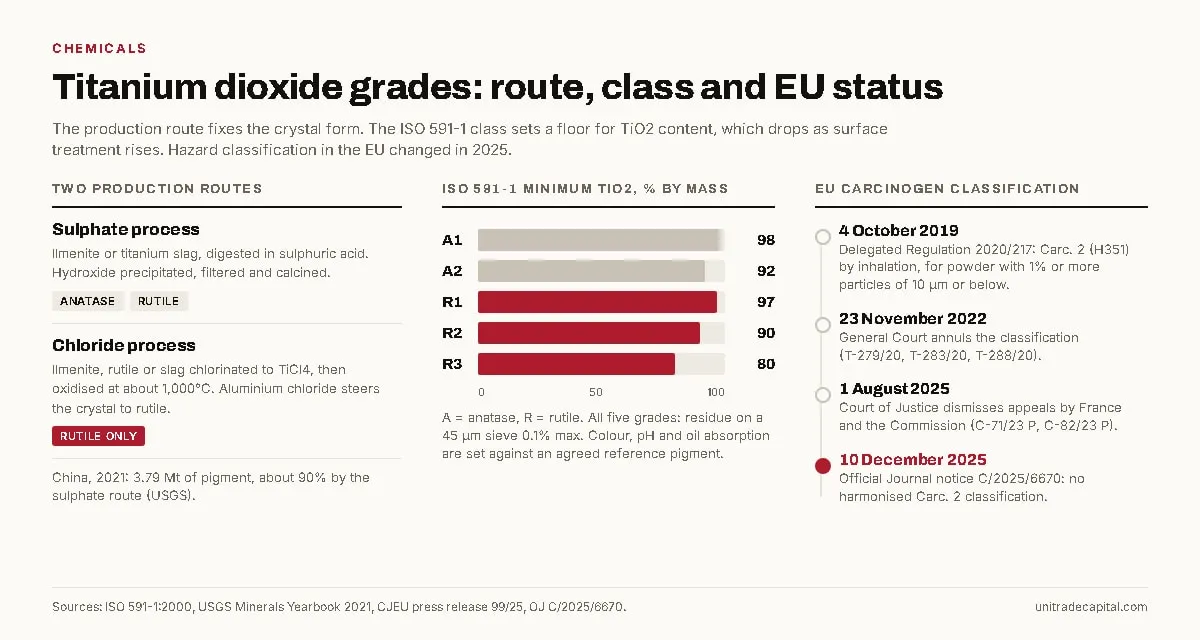
- Sulphate process: the plant digests ilmenite or titanium slag in sulphuric acid. The titanium then precipitates as a hydroxide, which the plant filters and calcines. This route can make either anatase or rutile.
- Chloride process: Feedstock such as ilmenite, rutile or slag reacts with chlorine and petroleum coke to form titanium tetrachloride, which the plant then oxidises at about 1,000°C. Adding aluminium chloride drives the product into the rutile form, so the chloride route makes rutile only.
Because titanium tetrachloride can be distilled to very low impurity levels, a 2000 PCI Magazine article states that chloride pigments generally show better brightness and colour. However, that is a general tendency, not a rule for every grade.
In 2021, China produced 3.79 million tonnes of TiO2 pigment, about 90% of it by the sulphate route, according to the USGS. By contrast, the same yearbook lists no sulphate-process producers at all in the United States. So when you compare Chinese and Western offers, you are often comparing two routes as well as two price levels.
How ISO 591-1 classifies titanium dioxide grades
The reference standard is ISO 591-1:2000, Titanium dioxide pigments for paints. It defines two types, Type A for anatase and Type R for rutile. It then splits them into five grades: A1 and A2, and R1, R2 and R3.
The classes differ mainly in their minimum TiO2 content by mass:
- A1: 98%
- A2: 92%
- R1: 97%
- R2: 90%
- R3: 80%
All five grades share a ceiling of 0.1% residue on a 45 µm sieve. The standard also caps water-soluble matter per grade. Matter volatile at 105°C has a fixed limit for A1, A2 and R1, while for R2 and R3 the parties must agree it.
The lower floors in these titanium dioxide grades do not signal a lower-quality pigment. Instead, they leave room for surface treatment. A heavily coated durable rutile simply contains less titanium dioxide by weight, so it lands in R2 rather than R1.
Colour, scattering power, pH, oil absorption and resistivity, however, are only conditional requirements. The standard says these must match an “agreed reference pigment” or be agreed between the parties. In other words, the class alone does not fix them. Your contract has to do that.
Surface treatment: what the ISO class does not show
After calcination, producers mill the crude pigment and coat it. The USGS names alumina, silica and organic compounds as typical treatments. The PCI Magazine article describes the main effects:
- Alumina is the most common layer, often applied last, and it helps dispersion.
- Dense silica gives the highest durability outdoors, although it tends to reduce gloss.
- Fluffy silica, deposited at acidic or neutral pH, raises oil absorption and lowers gloss, so it suits matt and flat finishes.
- Zirconia adds durability with little effect on optics, which is why “universal” high-gloss grades use it.
- Organic treatments such as polyols and silicones improve dispersion. Also, silicones make the surface water-repellent for plastics.
Across titanium dioxide grades, the treatment level shows up directly in the TiO2 figure. For example, one producer’s plastics guide lists a lightly treated grade at 97% TiO2 minimum. In the same guide, a maximum-durability grade carries up to 4.0% alumina and 6.5% silica, so its floor drops to 89%. Both are rutile, but they suit completely different jobs.
Reading the spec sheet line by line
Technical data sheets for titanium dioxide grades carry the same handful of lines. Each one maps to an ISO 787 test method.
TiO2 content. This confirms the ISO class and shows how much treatment the grade carries. ISO 591-1 gives two titration methods, aluminium reduction and chromium(II) chloride reduction.
Oil absorption (ISO 787-5). This measures how much oil a set mass of pigment takes up. A high value means the grade will demand more binder or resin. It also tends to rise with fluffy silica treatment.
Tinting strength or reducing power (ISO 787-24). This measures how well the white pigment lightens a coloured or black paste against a reference. A higher value means you can reach the same whiteness at a lower loading. According to the Chemours guide, lower loadings in plastics also reduce damage to the polymer’s mechanical properties.
pH of an aqueous suspension (ISO 787-9). This matters for stability in water-based paints and for interaction with other additives.
Sieve residue (ISO 787-18). This counts the coarse particles that can show up as specks or grit in a film.
Whiteness, brightness and undertone. Suppliers often report CIE L* and a measure of blue or yellow undertone. Since ISO 591-1 only asks for colour “similar” to the agreed reference, request the reference and the method in writing.
Matching titanium dioxide grades to the end use
Paint and coatings took 65% of US producer shipments in 2021, and plastics and rubber took 26%, according to the USGS. Each sector rewards different properties in titanium dioxide grades.
Coatings. Exterior paint needs rutile with a durable treatment, while interior paints can use anatase, as the USGS notes. Matt and flat paints can take a fluffy silica grade with higher oil absorption. High-gloss finishes, however, favour the alumina or zirconia treatments that keep gloss high.
Plastics and PVC. In thin films and extrusion coating, the Chemours plastics guide flags two concerns. The first is lacing, the holes and streaks that volatiles cause at high processing temperature. The second is discolouration. For exterior PVC window profiles, the same guide treats dense silica treatment as the way to minimise chalking. It also notes that grade choice depends on the heat stabiliser system in the compound. Therefore, a buyer should tell the supplier the resin, the stabiliser and the processing temperature, not just “PVC”. If you buy resin and pigment together, align the brief with your pvc resin supplier before you lock either spec.
Paper. The PCI article notes that anatase is less abrasive than rutile, which matters for paper machines and fibre.
Rubber. In the Chemours guide, the grade suggested for rubber and leather is an alumina-treated rutile with high tinting strength, a blue undertone and good resistance to yellowing. Still, confirm the choice with the compounder’s own trials before you approve any of these titanium dioxide grades.
Where EU rules on titanium dioxide stand in 2026
The regulatory picture changed in 2025, and old safety data sheets may still reflect the earlier position.
Commission Delegated Regulation (EU) 2020/217, adopted on 4 October 2019, classified titanium dioxide as a suspected carcinogen by inhalation (Category 2, H351). It applied only to powder forms containing 1% or more of particles with an aerodynamic diameter of 10 µm or below. Manufacturers and users challenged it. The General Court annulled the classification on 23 November 2022, in Cases T-279/20, T-283/20 and T-288/20.
France and the Commission appealed. On 1 August 2025, in Joined Cases C-71/23 P and C-82/23 P, the Court of Justice dismissed both appeals. The court found that the earlier assessment had not taken all relevant factors into account when weighing the key scientific study. Then, on 10 December 2025, an Official Journal notice (C/2025/6670) confirmed the result. Titanium dioxide in that powder form is not subject to harmonised classification as Carcinogenic Category 2. The related annexes and labelling notes of Regulation 2020/217 also count as annulled.
Food is a separate matter under separate law. Commission Regulation (EU) 2022/63 withdrew the authorisation of titanium dioxide as food additive E171. It entered into force on 7 February 2022, and food produced or placed on the EU market after 7 August 2022 may not contain it. The Food Safety Authority of Ireland reported in July 2022 that Great Britain still permitted the additive at that time.
What to ask a supplier before you sign
Most problems with titanium dioxide grades show up only after delivery. A few written questions at the offer stage prevent nearly all of them:
- Is the grade rutile or anatase, and which process made it, sulphate or chloride?
- Which ISO 591-1 class does it meet, and what surface treatment does it carry?
- What are the guaranteed values for TiO2 content, oil absorption, tinting strength, pH and sieve residue, and by which methods?
- What reference pigment does the colour comparison use?
- Is the safety data sheet current with the 2025 EU position?
Ask for a certificate of analysis for each lot, and keep a retained sample from your first approved shipment. If a later lot drifts, that sample is your reference.
Unitrade Capital Solution supplies palm and oleochemicals, rubber and latex, industrial chemicals and paper to buyers in over 20 countries. If you need a titanium dioxide supplier or want to compare grades against your application, tell us what you need and we will come back to you. You can also see our full range as an industrial chemical supplier.
This article is general information and is not legal or technical advice. Verify grade suitability with your own trials and check regulatory status against EUR-Lex and the current safety data sheet before relying on it.
Sources
- ISO 591-1:2000 Titanium dioxide pigments for paints, Part 1: Specifications and methods of test (preview) ISO, via iTeh Standards
- 2021 Minerals Yearbook: Titanium (advance release) U.S. Geological Survey
- Mineral Commodity Summaries 2026: Titanium and titanium dioxide U.S. Geological Survey
- Tailoring TiO2 Treatment Chemistry To Achieve Desired Performance Properties PCI Magazine
- Titanium Dioxide Grade Selection for Plastics Chemours (Ti-Pure)
- Press Release No 99/25: The Court of Justice upholds the annulment of the classification of titanium dioxide in certain powder forms as a carcinogenic substance Court of Justice of the European Union
- Notice concerning the harmonised classification of titanium dioxide as Carcinogenic Category 2 via inhalation (C/2025/6670) Official Journal of the European Union
- Titanium Dioxide is No Longer Authorised as a Food Additive in the EU from 7 August 2022 Food Safety Authority of Ireland