MSPO, RSPO, ISCC or MSNR: what each palm and rubber certificate actually proves
Sustainability certification for palm oleochemicals and rubber: what MSPO, RSPO, ISCC and MSNR prove, what HALAL or FSSC 22000 cover, and what to ask for.
A sustainability certification on a palm or rubber offer usually proves less than the buyer assumes. The gap tends to surface at the worst moment. Your customer asks whether the glycerin in a shipment is RSPO Segregated, but the paperwork only says RSPO. Or an auditor wants a valid FSSC 22000 certificate for the plant that made the stearic acid. The one on file, however, covers a different site.
Each scheme answers a narrow question. So the useful skill is knowing which question each certificate answers, and which logo answers nothing that your customer is actually asking.
Three questions, three kinds of certificate
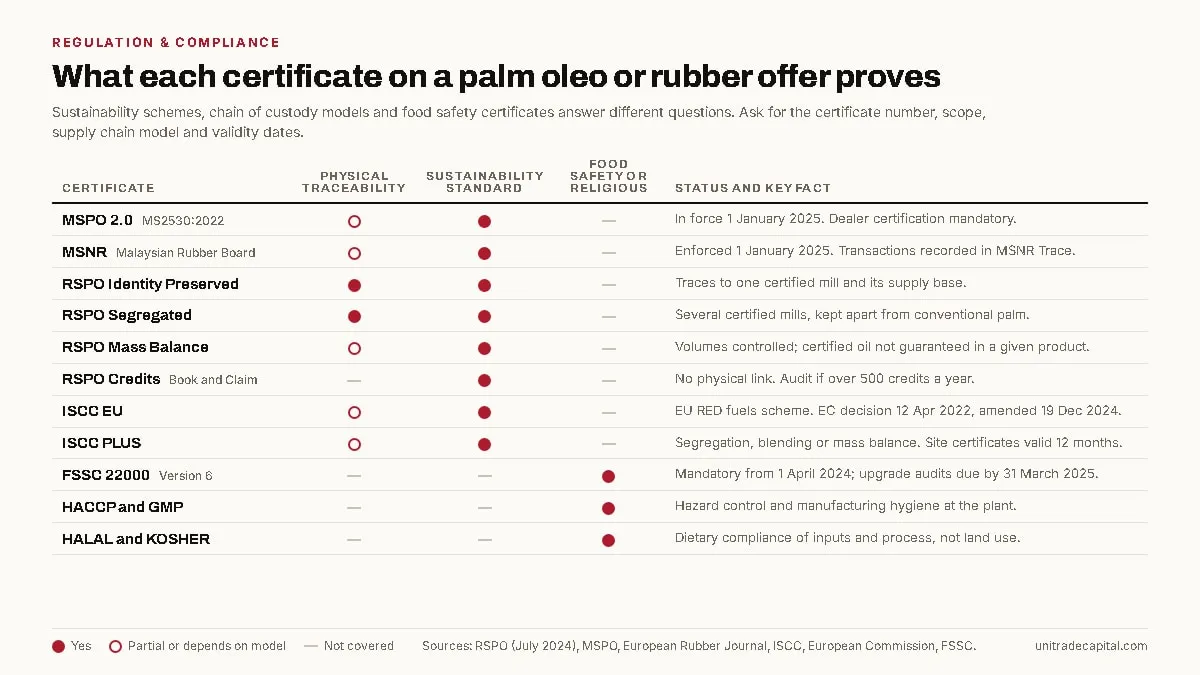
Almost every certificate you see on an oleochemical or natural rubber offer answers one of three questions. First, where did the raw material come from, and can anyone trace it? Second, was it grown and processed to a defined environmental and social standard? Third, is the finished product safe, clean and acceptable for a food, pharmaceutical or religious market?
Traceability sits inside several schemes, such as MSNR Trace for rubber and the chain of custody rules of RSPO and ISCC. Sustainability certification answers the second question, and in this trade that means MSPO, MSNR, RSPO and ISCC. Food safety and religious compliance belong to HACCP, GMP, FSSC 22000, HALAL and KOSHER.
The overlap is smaller than it looks. A HALAL certificate says nothing about deforestation. Likewise, an RSPO Mass Balance claim says nothing about microbial limits. When a spec sheet lists six logos, read it as six separate answers, each to its own question.
MSPO and MSNR: national sustainability certification in Malaysia
Malaysia runs its own schemes for both crops. For palm, the Malaysian Sustainable Palm Oil standard moved to its second edition, MS2530:2022, which the industry calls MSPO 2.0. It came into force on 1 January 2025. According to MSPO (April 2025), the revision tightened traceability and made dealer certification mandatory. As a result, the standard now reaches further down the supply chain than the 2013 edition did. MSPO also described greenhouse gas management and High Conservation Value areas as additions still to come.
For rubber, the Malaysian Rubber Board (LGM) runs Malaysian Sustainable Natural Rubber, or MSNR. Enforcement began on 1 January 2025. The scheme rests on five principles: no deforestation, cultivation under the National Land Code, environmental sustainability, social compliance and supply chain traceability. From July 2024 the Board assessed smallholders and licence holders, and that work included collecting geolocation data for rubber holdings. It also built MSNR Trace, a digital platform that records raw rubber transactions along the chain. A ceremony on 12 December 2024 marked the first MSNR-certified shipment to the EU, according to the European Rubber Journal.
What the national schemes prove is useful but bounded. An MSPO or MSNR sustainability certification shows that a named operation met a national standard at its last audit. However, neither proves by itself that a given SMR 20 lot or fatty acid tank came from certified land. For that, you need the transaction record behind the certificate.
RSPO supply chain models: what the claim really covers
The Roundtable on Sustainable Palm Oil (RSPO) audits plantations and mills against its Principles and Criteria. After the mill, material moves under one of four supply chain models, which RSPO describes in factsheets dated 1 July 2024. For an oleochemicals buyer, these models matter more than the plantation standard. That is because they decide what you can truthfully claim.
Identity Preserved (IP) material traces back to a single certified mill and its supply base. It stays separate from all other material through shipping, storage and processing.
Segregated (SG) material also comes only from certified sources, but from several mills mixed together. Even so, it stays fully separate from conventional palm.
Mass Balance (MB) lets a site mix certified and uncertified palm, physically or on paper, as long as it controls the overall quantities. RSPO states plainly that MB does not guarantee certified oil is present in a given product. Still, RSPO calls the model essential for oleochemicals. Many derivative plants cannot keep separate tanks, or cannot reach minimum runs with certified feed alone.
Book and Claim (RSPO Credits) removes the physical link entirely. A buyer purchases credits from certified smallholders, mills or crushers to offset conventional volumes. The product itself may contain no certified palm at all. Brands that buy credits need no supply chain certification. However, they do need an audit if they claim more than 500 credits in a calendar year.
If you buy refined glycerin or deal with a stearic acid supplier, MB is the model you will meet most often. So if your customer needs a physically certified ingredient, ask for SG or IP in writing at enquiry.
ISCC EU and ISCC PLUS: sustainability certification for two different markets
International Sustainability and Carbon Certification (ISCC) runs two schemes that buyers often confuse. ISCC EU exists for the EU Renewable Energy Directive. The European Commission lists it among its recognised voluntary schemes, under a decision of 12 April 2022 that it amended on 19 December 2024. Its scope covers biofuels, bioliquids, biomass fuels and related fuels, across the full fuel chain. In other words, ISCC EU matters when palm-derived material is heading for an energy use in Europe.
ISCC PLUS is the voluntary scheme for other markets, including food and feed, plastics, packaging and textiles. It allows three chain of custody options: physical segregation, controlled blending and mass balance. Every site that handles the material needs its own valid certificate, and ISCC issues certificates per site with 12 months of validity.
That validity period is the practical point. An ISCC PLUS sustainability certification that lapsed in June does not cover a cargo loaded in September. Only a renewed certificate with matching dates would.
Food safety and religious certificates on an oleo spec sheet
The logos most often printed on an oleochemical spec sheet are not sustainability schemes at all. Instead, they concern the plant and the product.
HACCP (hazard analysis and critical control points) is a method for identifying food safety hazards and controlling them at defined steps. GMP, or good manufacturing practice, covers the basics of hygiene, equipment and documentation. FSSC 22000 is a full food safety management scheme that the Global Food Safety Initiative (GFSI) recognises. Version 6 became mandatory for all new certifications on 1 April 2024. Certified sites then had to complete their upgrade audit before 31 March 2025. Therefore, any FSSC 22000 certificate you receive in late 2026 should reference Version 6.
HALAL and KOSHER confirm that a product and its process meet Islamic and Jewish dietary requirements respectively. They tell a food or pharmaceutical buyer something real about inputs and handling, but nothing about land use. None of these five counts as a sustainability certification, however useful they are.
Unitrade’s own Palm & Oleo products carry HALAL, HACCP, GMP, KOSHER and FSSC 22000 certification depending on product and grade. That is exactly why the certificate for the specific grade matters more than a company-level list.
How to check a sustainability certification before you sign
A logo on a spec sheet is a claim, while a certificate is evidence. Before you rely on any sustainability certification, ask for the certificate itself and check four things.
Certificate number. RSPO tells SG and IP buyers to expect a valid supply chain certification number from the direct supplier. The SG or IP statement should come with it. Check that number against the scheme owner’s public register, not only against the PDF in your inbox.
Scope. Confirm the certificate names the site that produced or handled your material, and the product in question. Under ISCC PLUS, for example, each site in the chain needs its own certificate.
Supply chain model. For RSPO and ISCC PLUS, the model decides the claim. MB, SG and IP are different products commercially, even when the chemistry is identical.
Validity. Compare the issue and expiry dates with the loading date, not the contract date.
Then write it into the contract. When a customer needs a specific claim, such as RSPO SG glycerin, put the scheme and model in the order. List the documents you expect with each shipment as well. A vague clause asking for “sustainable material” settles nothing when a dispute arrives.
Where EUDR fits
The EU Deforestation Regulation raises the stakes, because it asks for plot-level evidence rather than a scheme logo. We covered the regulation itself in our guide to EUDR for Malaysian exporters, so one point is enough here. No sustainability certification replaces the due diligence statement an operator must file.
MSPO, MSNR, RSPO and ISCC records can feed that file, but each one helps only as far as its traceability reaches. Mass Balance and Book and Claim claims, for instance, cannot show that a product came from specific certified plots. If you buy from a natural rubber supplier in Malaysia, ask whether the lot sits inside MSNR Trace. Also ask which records will come with it.
Certificates are tools for different jobs. Match each one to the question your customer is asking, and check the number, scope, model and dates every time.
Unitrade Capital Solution supplies palm oleochemicals, rubber and latex, industrial chemicals and paper to buyers in over 20 countries, and is a registered member of the Malaysian Rubber Board (LGM) licensed to export Standard Malaysian Rubber. If you need certificate copies for a specific grade before you order, tell us what you need and we will tell you what we can evidence.
This article is general information and is not legal or certification advice. Verify scheme rules against the current documents published by RSPO, MSPO, the Malaysian Rubber Board, ISCC and Foundation FSSC before relying on them.
Sources
- Segregated and Identity Preserved Supply Chain Models: added value of traceability for transforming supply chains Roundtable on Sustainable Palm Oil (RSPO)
- Mass Balance Supply Chain Model: where flexibility allows market access Roundtable on Sustainable Palm Oil (RSPO)
- Book and Claim Supply Chain Model: sustainability at scale with RSPO Credits Roundtable on Sustainable Palm Oil (RSPO)
- MSPO 2.0: A New Era of Sustainable Palm Oil Production, within the first quarter Malaysian Sustainable Palm Oil (MSPO)
- Malaysia ships first rubber under EUDR compliance scheme European Rubber Journal
- ISCC PLUS certification International Sustainability and Carbon Certification (ISCC)
- Voluntary schemes European Commission, Directorate-General for Energy
- FSSC 22000 Version 6 Becomes Mandatory as of 1 April 2024 Foundation FSSC