
SMR grades explained: what CV, L, 5, 10, 20 and GP mean for a rubber buyer
SMR grades set limits for dirt, ash, nitrogen, volatile matter, PRI and Mooney. What each number means, how SIR, STR and SVR compare, and how to choose.
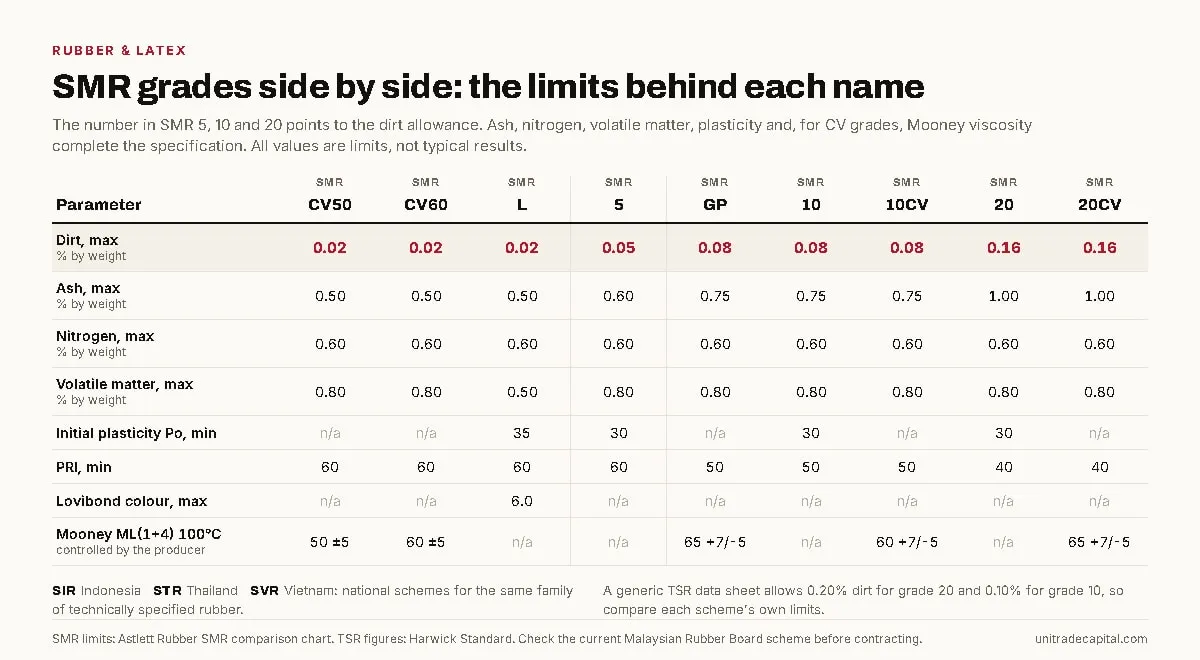
SMR grades decide whether a bale of natural rubber suits a tyre, a pale product or a demanding technical part. So a buyer who reads only the number in the name can pay for the wrong rubber. The grade sets limits on dirt, ash, nitrogen, volatile matter and plasticity. For some grades, it also fixes the viscosity.
This guide walks through each Standard Malaysian Rubber (SMR) grade, what its numbers mean, and how it compares with the Indonesian, Thai and Vietnamese schemes. Then it turns to choosing a grade for the job.
What the SMR grades are, and who sets them
The Rubber Research Institute of Malaysia introduced the SMR scheme in 1965. Today the Malaysian Rubber Board (MRB, known locally as LGM) oversees it. The MRB describes SMR as a technical grading system. In other words, it grades rubber on measured properties such as dirt content and plasticity, rather than on how the rubber looks.
That is the key difference from ribbed smoked sheet. If you buy RSS rubber, a grader judges the sheet by eye. With SMR, by contrast, a laboratory tests a sample and the result decides the grade.
The international family name for this kind of rubber is technically specified rubber, or TSR. ISO 2000:2020 gives guidance on how to specify it. It proposes a grading system based on the origin of the rubber and on its measured properties. ASTM D2227, reaffirmed in 2026, does the same job in the American system. It sets requirements for five grades and states that no grade may contain skim rubber.
The SMR grades in common use are CV50, CV60, L, 5, GP, 10, 10CV, 20 and 20CV. The MRB’s own overview names SMR 5, GP, 10 and 20 as the grades that serve different industrial needs.
The number in the name: dirt content
For SMR 5, 10 and 20, the number points to the dirt allowance. Dirt here means foreign matter that a fine sieve holds back during the test.
The limits in the SMR comparison chart from Astlett Rubber are 0.05% dirt by weight for SMR 5, 0.08% for SMR 10 and 0.16% for SMR 20. SMR CV50, CV60 and L share a tighter cap of 0.02%. SMR GP sits with SMR 10 at 0.08%.
So the number is a label, not the actual percentage. SMR 20 does not allow 0.20% dirt in that chart. However, a generic TSR data sheet from Harwick Standard lists 0.20% for TSR 20 and 0.10% for TSR 10. That gap matters, and the section on equivalents below returns to it.
Dirt also follows the raw material. Harwick notes that TSR L comes from high-quality latex, which is why it is so clean. SMR 5 has two sub-grades in the chart. SMR 5RSS comes from ribbed smoked sheets baled directly, and SMR 5ADS from air-dried sheets.
Ash, nitrogen and volatile matter
Dirt is only the first line on a certificate. Three more limits follow, and each one tells a compounder something different.
Ash is the mineral residue left when you burn a sample. The chart allows 0.50% for the CV grades and SMR L, 0.60% for SMR 5, 0.75% for GP and SMR 10, and 1.00% for SMR 20. So the cleaner grades also carry less mineral matter.
Nitrogen gives an indirect reading of the protein left in the rubber. The chart sets 0.60% as the maximum for every SMR grade. Because the limit is the same across the scheme, nitrogen rarely decides the grade choice. Still, it is worth checking on each lot.
Volatile matter is mostly moisture. The limit is 0.80% for most SMR grades, but SMR L is tighter at 0.50%. Wet rubber weighs more than dry rubber, so this figure also protects the buyer on weight.
Each of these is a maximum. A lot that passes may sit well below the limit, or just under it. Therefore, ask for the actual test results of each lot rather than relying on the grade name alone.
Plasticity and Mooney: how SMR grades behave in the mixer
The next group of limits deals with how the rubber processes, rather than how clean it is.
Po is the initial Wallace plasticity. It measures how stiff the raw rubber is before any ageing. The chart sets a minimum Po of 30 for SMR 5, 10 and 20, and 35 for SMR L.
PRI, the plasticity retention index, compares plasticity after a heat-ageing step with plasticity before it. A high PRI means the rubber resists breakdown by oxidation. The minimum is 60 for the CV grades, SMR L and SMR 5. It is 50 for GP and SMR 10, and 40 for SMR 20. As a result, PRI is the second clear step between SMR grades after dirt.
Mooney viscosity matters most for the CV grades. CV stands for constant viscosity. According to Harwick Standard, producers treat CV rubber chemically so that it meets and keeps a set Mooney value, most often 60 or 50. The chart gives 50 plus or minus 5 for CV50 and 60 plus or minus 5 for CV60, measured as ML(1+4) at 100°C. It also marks the Mooney figures as controlled by the producer rather than formal specification limits, so agree the range in the contract.
Why pay for constant viscosity? Harwick notes that TSR 20 and 10 harden in storage. A plant can reverse that with pre-mastication, a hot room or a peptiser, but each step costs time. CV grades, on the other hand, stay more stable and normally need none of that work.
SMR, SIR, STR and SVR: equivalent, but check the sheet
SMR is the Malaysian scheme. SIR is Indonesian, STR is Thai and SVR is Vietnamese. All four produce technically specified rubber, and the grade numbers follow the same logic.
Harwick’s data sheet says SIR 20 and SMR 20 must meet the same technical requirements. However, its own TSR table allows 0.20% dirt for grade 20, while the SMR chart allows 0.16%. So the sources do not fully agree, and each national scheme sets its own limits. Treat the grades as close equivalents, not as identical products.
The national rules also differ in detail. Indonesia’s trade ministry issued Permendag 1/2026, enacted on 7 January 2026 and promulgated on 14 January 2026. It requires exported SIR to meet SNI 1903:2017. It also ties raw material to grade: SIR 3CV, 3L, 3WF and LoV come from field latex, while SIR 10 and SIR 20 come from field coagulum or sheet rubber. Note that the Pasal.id copy we read was still marked as not yet reviewed.
Thailand shows a shared method instead. A TISI scope of accreditation for an STR testing laboratory, valid from 2023 to 2028, lists SMR Bulletin No. 7 as the test method for dirt, ash, volatile matter, nitrogen, plasticity and Mooney. So a Thai lab and a Malaysian lab may use the same methods even when the limits differ.
In short, the comparison between SMR grades and their SIR, STR or SVR equivalents works best at the level of the certificate. Compare test results, not names.
Choosing between SMR grades for your end use
Start from the product you make, and then work back to the cheapest grade that meets its needs.
Tyres and heavy goods. Harwick calls TSR 20 the most common grade on the market. It lists TSR 20 and 10 for uses such as tyres and conveyor belts. So SMR 20 or an equivalent is the usual starting point for a tyre compound. Your compounder still decides, because tread and inner liner recipes differ.
Cleaner technical goods. When a thinner or more demanding part needs fewer particles, move up to SMR 10 or SMR 5. SMR 10 also brings a higher PRI floor, at 50 instead of 40.
Light-coloured goods. SMR L comes from high-quality latex and carries a colour limit. The chart sets a maximum Lovibond colour of 6.0. That makes SMR L the grade for pale products, where a dark rubber would show.
Consistent processing. If your line struggles with batch-to-batch viscosity, CV50 or CV60 may cost less overall. You avoid the mastication step, and the mix behaves more evenly.
Whatever the grade, the rubber is only part of the recipe. A compound also needs curing chemicals such as rubber accelerators, and their dosage depends on the base rubber.
Writing SMR grades into a contract
On a purchase order, a grade name is a start, not a specification. Several habits close the gaps.
First, name the scheme and the grade together, for example SMR 20 rather than TSR 20. Then the limits follow the Malaysian scheme, not a generic table.
Second, list the parameters that matter to you, such as dirt, PRI and, for CV grades, the Mooney range. ISO 2000:2020 itself says its criteria need agreement between the parties. So write the limits down.
Third, ask for a certificate of analysis for each lot, and agree the test method. SMR Bulletin No. 7 sets out the SMR test methods, and the Thai STR laboratory scope above cites it too.
Finally, if you accept more than one origin, state which equivalents you will take. A contract that allows SMR 20 or STR 20 gives a natural rubber supplier more room in a tight month. Our earlier article on wintering and rubber supply explains when those tight months fall.
Clear SMR grades on paper prevent most quality disputes before the rubber ships.
Unitrade Capital Solution supplies palm and oleochemicals, rubber and latex, industrial chemicals and paper to buyers in over 20 countries. We are a registered member of the Malaysian Rubber Board with an approved licence to export SMR. If you need help matching a grade to your compound, tell us what you need and we will come back to you.
This article is general information and is not technical advice. The limits quoted are drawn from published charts, so verify them against the current Malaysian Rubber Board SMR scheme, or the relevant national standard, before relying on them.
Sources
- MRB Experiential Centre: Standard Malaysian Rubber (SMR) Malaysian Rubber Board (LGM)
- Standard Malaysian Rubber (SMR): Natural Rubber Comparison Chart Astlett Rubber Inc.
- Technical Data Sheet: Technically Specified Rubber Harwick Standard Distribution Corporation
- ISO 2000:2020 Rubber, raw natural: Guidelines for the specification of technically specified rubber (TSR) Estonian Centre for Standardisation and Accreditation (EVS)
- ASTM D2227-96(2026) Standard Specification for Natural Rubber (NR) Technical Grades ASTM International
- Peraturan Menteri Perdagangan Nomor 1 Tahun 2026 (Permendag 1/2026) on technically specified natural rubber Pasal.id
- Scope of Accreditation for Testing, Certification No. 23-LB0190 (STR and STR 20 CV) Thai Industrial Standards Institute (TISI)